o-Xylene (ortho-xylene) has a melting point of approximately -25.2°C and a boiling point of 144.5°C. Although it shares the same molecular formula and molecular weight as the other xylene isomers, differences in molecular structure affect its physical properties. Understanding the xylene boiling point and melting point requires examining how molecular structure influences intermolecular forces and crystal packing.
View o-Xylene Specifications and Purity
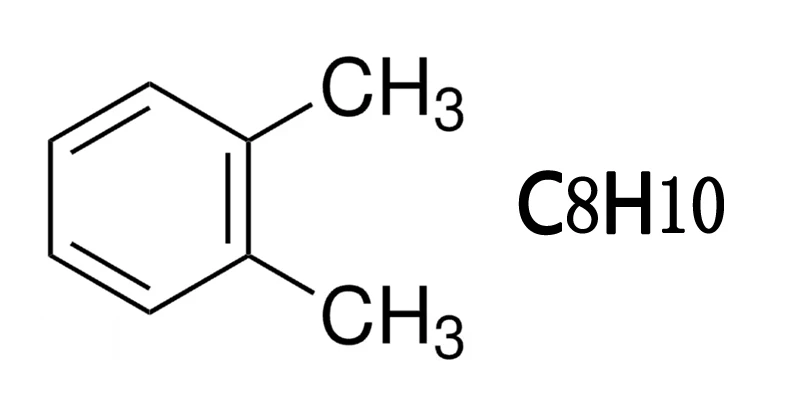
What Is the Boiling Point of o-Xylene?
The boiling point of ortho xylene is approximately 144.5°C at atmospheric pressure (101.325 kPa). Among the three xylene isomers, o-xylene has the highest boiling point, slightly above m-xylene and p-xylene.
The boiling point of o-xylene is influenced by intermolecular interactions, including London dispersion forces and dipole–dipole interactions. Its molecular structure gives it a nonzero dipole moment, which contributes to intermolecular attraction in the liquid state.
As a result, more energy is required to separate o-xylene molecules during vaporization, giving it a higher boiling point than the other two isomers.
Why Does o-Xylene Have a Low Melting Point?
The o-xylene melting point is approximately -25.2°C. Its relatively low melting point is associated with the arrangement of molecules in the solid crystal structure.
In o-xylene, the two methyl groups are attached to adjacent carbon atoms on the benzene ring. This arrangement gives the molecule less symmetry than p-xylene and influences how efficiently molecules pack together in a crystal lattice.
By comparison, p-xylene has a more symmetrical molecular structure, allowing more efficient crystal packing and contributing to its higher melting point of approximately 13.2°C.
However, molecular symmetry alone does not determine melting points. The particularly low melting point of m-xylene also reflects its specific crystal structure and packing behavior.
How Do the Boiling Points of Xylene Isomers Compare?
The three xylene isomers have the same molecular formula (C₈H₁₀) and molecular weight (106.16 g/mol), but their boiling points differ because of their molecular arrangements and intermolecular interactions.
| Xylene Isomer | Boiling Point | Melting Point |
|---|---|---|
| o-Xylene (Ortho-Xylene) | 144.5°C | -25.2°C |
| m-Xylene (Meta-Xylene) | 139.1°C | -47.8°C |
| p-Xylene (Para-Xylene) | 138.4°C | 13.2°C |
The p-xylene boiling point is approximately 138.4°C, slightly lower than those of o-xylene and m-xylene. This comparison shows that even though the three isomers share the same molecular formula, their physical properties vary with the positions of their methyl groups.
The boiling point of xylenes is therefore not a single fixed value for every xylene product. For mixed xylene, the boiling range depends on the proportions of individual isomers and other components in the mixture.
Why Do Xylene Melting and Boiling Points Matter for Industrial Buyers?
The melting and boiling points of xylene isomers are important when evaluating their storage, handling, separation, and industrial applications.
For buyers sourcing industrial xylene, it is essential to distinguish between individual isomers and mixed xylene. Their compositions and physical properties are not interchangeable.
Before purchasing, buyers should confirm the required isomer, purity, composition, and technical specifications. Reviewing the product TDS, SDS, and COA helps ensure that the selected material meets the requirements of the intended application.