



Xylene vs Mixed Xylene: Are They the Same?
In most industrial solvent applications, xylene and mixed xylene refer to the same commercial product, commonly identified by CAS 1330-20-7. Mixed xylene contains three xylene isomers-ortho, meta and para-often alongside ethylbenzene. However, xylene can also refer to an individual isomer. Buyers should confirm the CAS number and composition before ordering.
| Term | Common Meaning |
|---|---|
| Xylene | General name for dimethylbenzene or commercial xylene solvent |
| Mixed Xylene | Mixture of xylene isomers, often containing ethylbenzene |
| Xylol | Traditional commercial name for xylene |
| Total Xylenes | Combined concentration of o-, m- and p-xylene, normally excluding ethylbenzene |
In comparisons of xylene vs xylenes, the distinction is often grammatical or contextual rather than a difference in chemical identity. The plural term "xylenes" generally refers to the three isomers collectively.
For detailed composition, purity and packaging information, view our mixed xylene product specifications.
What Is Mixed Xylene?
Mixed xylene (CAS 1330-20-7) is an aromatic hydrocarbon solvent produced mainly through petroleum refining and petrochemical processing. It is widely used in coatings, inks, adhesives and industrial cleaning.
Commercial mixed xylene usually contains m-xylene, p-xylene, o-xylene and ethylbenzene. Their proportions depend on the feedstock, production process and product grade.
Typical Mixed Xylene Composition
| Component | CAS Number | Illustrative Range |
|---|---|---|
| m-Xylene | 108-38-3 | 40–65% |
| p-Xylene | 106-42-3 | 15–25% |
| o-Xylene | 95-47-6 | 15–25% |
| Ethylbenzene | 100-41-4 | 4–20% |
These are illustrative ranges, not guaranteed specifications. Actual mixed xylene composition should be confirmed through the supplier's COA.
Ethylbenzene in xylene is an important purchasing consideration. Although ethylbenzene has the same molecular formula (C₈H₁₀) as xylene, it is not one of the three xylene isomers.
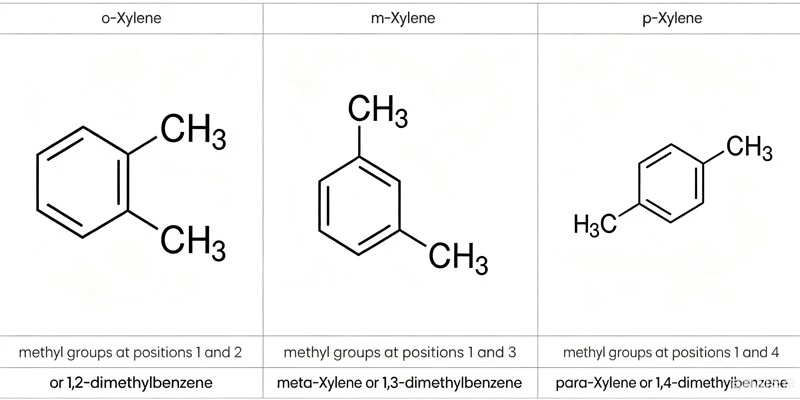
For a closer look at their properties and industrial uses, compare o-xylene, m-xylene and p-xylene.
Xylene vs Mixed Xylene vs Individual Isomers
The three xylene isomers share the same molecular formula but differ in the positions of their methyl groups. These structural differences affect their melting points and industrial applications.
| Property | o-Xylene | m-Xylene | p-Xylene | Mixed Xylene |
|---|---|---|---|---|
| CAS Number | 95-47-6 | 108-38-3 | 106-42-3 | 1330-20-7 |
| Melting Point | −25.2°C | −47.9°C | 13.2°C | Composition-dependent |
| Boiling Point | 144.4°C | 139.1°C | 138.4°C | Approx. 137–144°C |
| Main Application | Phthalic anhydride | Isophthalic acid | PTA production | Industrial solvents |
Mixed xylene cannot directly replace a high-purity individual isomer in chemical manufacturing. For example, p-xylene is used to produce purified terephthalic acid (PTA), an important raw material for polyester production.
For coatings and industrial cleaning, mixed xylene is often more practical because the application does not necessarily require a purified isomer.
When Does the Difference Matter?
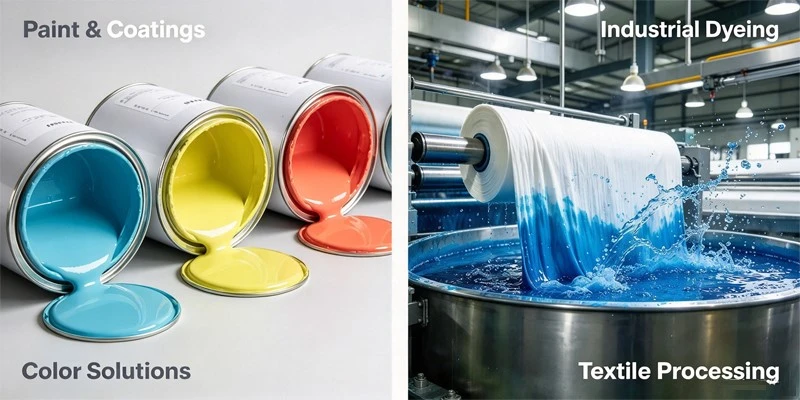
Paints, Coatings and Inks
Mixed xylene is commonly used as a solvent in alkyd coatings, selected epoxy formulations, printing inks and adhesives.
Its aromatic solvency helps dissolve compatible resins, while its evaporation characteristics provide time for coating flow and leveling.
When replacing one xylene grade with another, manufacturers should compare the distillation range, ethylbenzene content and resin compatibility.
Chemical Manufacturing
Individual xylene isomers are selected for specific chemical reactions.
o-Xylene is mainly used for phthalic anhydride, m-xylene for isophthalic acid and p-xylene for terephthalic acid.
Using mixed xylene instead of a specified isomer can introduce unwanted components into the manufacturing process.
What Xylene Specifications Should Buyers Check?
A xylene specification should confirm chemical composition, product quality and batch consistency. The product name alone is not enough.
| Parameter | Purchasing Requirement |
|---|---|
| CAS Number | Confirm 1330-20-7 for mixed xylene |
| Total Xylenes | Required combined isomer percentage |
| Ethylbenzene | Specified content or maximum limit |
| Distillation Range | Agreed boiling range |
| Water Content | Maximum allowable moisture |
| Color | APHA specification |
| Sulfur Content | Limit based on application |
| Nonvolatile Residue | Maximum acceptable residue |
| Documentation | COA, TDS and SDS |
For example, a buyer requesting 90% minimum total xylenes should verify that the combined o-, m- and p-xylene content meets this requirement without counting ethylbenzene.
The Certificate of Analysis (COA) should provide actual batch results, while the Technical Data Sheet (TDS) describes typical product properties. The Safety Data Sheet (SDS) covers hazards, handling and transport information.
Before placing an order, request the latest mixed xylene COA to verify isomer composition, ethylbenzene content and batch specifications.
Safety and Handling
Xylene and mixed xylene are flammable liquids that require suitable ventilation, ignition-source control and safe storage.
The U.S. OSHA permissible exposure limit for xylene is 100 ppm as an eight-hour time-weighted average. NIOSH recommends 100 ppm as a TWA and 150 ppm for short-term exposure.
Mixed xylene is commonly transported as UN 1307, Class 3, Packing Group III. Buyers should verify the latest SDS and applicable transport regulations.
Frequently Asked Questions
Is mixed xylene the same as xylol?
In the xylene vs xylol comparison, the difference is mainly terminology. Xylol is a traditional name for xylene and often refers to commercial mixed xylene.
Does mixed xylene contain ethylbenzene?
Yes, many commercial grades contain ethylbenzene. Its concentration depends on the production process and product specification.
Can mixed xylene replace p-xylene?
Not in applications requiring high-purity p-xylene, such as PTA production. Mixed xylene may be suitable for compatible industrial solvent applications.
What does total xylenes mean?
Total xylenes generally refers to the combined concentration of o-xylene, m-xylene and p-xylene, excluding ethylbenzene.
Conclusion
The key difference in xylene vs mixed xylene is how the product name is used. Xylene may describe an individual isomer or a commercial mixture, while mixed xylene specifically refers to a mixture of xylene isomers.
Before purchasing, confirm the product name, CAS number and batch composition.
Tianjin Gnee Biotech Co., Ltd. supplies industrial-grade mixed xylene (CAS 1330-20-7) for coatings, inks, adhesives and other industrial applications.
Request a Mixed Xylene COA, SDS or Bulk Quote to review product specifications, packaging options and pricing.



