



Dimethyl sulfoxide (DMSO, CAS 67-68-5) is an organosulfur compound with the molecular formula C₂H₆OS. The structure of DMSO consists of two methyl groups (CH₃) bonded to a central sulfur atom, which is also connected to an oxygen atom. This arrangement gives DMSO its strong molecular polarity and makes it an important polar aprotic solvent in organic synthesis and chemical manufacturing.
Understanding the structure of DMSO helps explain its molecular properties, water miscibility, moisture absorption, and solvent behavior. These characteristics are also relevant to industrial buyers when evaluating DMSO specifications, purity grades, and product suitability.

What Is the Chemical Structure of DMSO?
The chemical structure of DMSO is commonly represented by the structural formula (CH₃)₂S=O. Each molecule contains two methyl groups, one sulfur atom, and one oxygen atom connected through a sulfoxide functional group.
| Chemical identifier | Information |
|---|---|
| Chemical name | Dimethyl sulfoxide |
| Abbreviation | DMSO |
| CAS number | 67-68-5 |
| Molecular formula | C₂H₆OS |
| Chemical Structure | 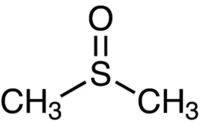 |
| Structural formula | (CH₃)₂S=O |
| Molecular weight | 78.13–78.14 g/mol |
| SMILES | CS(=O)C |
| Functional group | Sulfoxide |
The sulfur atom is the central atom, connecting both methyl groups to the oxygen atom. Unlike nonpolar hydrocarbon solvents, DMSO contains a polar sulfoxide functional group. This structural feature is responsible for many of its distinctive chemical properties.
What Is the Lewis Structure of DMSO?
The Lewis structure of DMSO is commonly written as CH₃–S(=O)–CH₃, showing a central sulfur atom bonded to two methyl groups and one oxygen atom. A charge-separated representation is also used to illustrate the polarized sulfur–oxygen bond.
Common representation:
CH₃–S(=O)–CH₃
Charge-separated representation:
CH₃–S⁺(–O⁻)–CH₃
Both representations describe the same molecule. The S=O notation is widely used in chemical formulas, while the S⁺–O⁻ representation highlights the uneven distribution of electron density across the sulfur–oxygen bond.
Oxygen attracts electron density more strongly than sulfur, creating a highly polarized bond. This polarization contributes significantly to DMSO's molecular dipole and explains why it behaves differently from nonpolar solvents.
What Is the Three-Dimensional Structure of DMSO?
The three-dimensional structure of DMSO is non-planar around its central sulfur atom, with two methyl groups, one oxygen atom, and a lone pair contributing to its molecular arrangement. This geometry, together with the polarized S–O bond, gives DMSO a substantial molecular dipole.
The two methyl groups are identical, and the sulfur atom is not a stereogenic center in ordinary DMSO.
This three-dimensional arrangement helps explain why DMSO interacts strongly with polar substances and has different solvent properties from nonpolar hydrocarbons.
How Does the Structure of DMSO Affect Its Chemical Properties?
The structure of DMSO determines several important chemical properties, including high polarity, polar aprotic behavior, hygroscopicity, and a relatively high boiling point. These characteristics result mainly from its polarized sulfur–oxygen bond and the hydrogen-bond-accepting ability of its oxygen atom.
- Polarity: DMSO is highly polar because the S–O bond has an uneven distribution of electron density. Its molecular dipole moment is approximately 4 debye, allowing it to interact with many polar compounds and ions.
- Polar aprotic behavior: DMSO is classified as a polar aprotic solvent because it has a strongly polar structure but no O–H or N–H bond. Its oxygen atom can accept hydrogen bonds, but DMSO cannot donate hydrogen bonds in the conventional way.
- Hygroscopicity: DMSO absorbs moisture from the surrounding environment because its oxygen atom can accept hydrogen bonds from water molecules. This also explains why DMSO is completely miscible with water. For moisture-sensitive applications, buyers should check the water-content limit in the product specifications. Karl Fischer titration is commonly used to measure water content.
- High boiling point: DMSO has a boiling point of approximately 189°C at atmospheric pressure. Strong intermolecular interactions contribute to this relatively high boiling point compared with many common organic solvents.
What Are the Key Physical Properties of DMSO?
The key physical properties of DMSO include a molecular weight of approximately 78.13–78.14 g/mol, a melting point near 18.5°C, and a boiling point near 189°C at atmospheric pressure. These values help identify the chemical and explain its handling and storage behavior.
| Property | Typical value |
|---|---|
| Molecular formula | C₂H₆OS |
| Molecular weight | 78.13–78.14 g/mol |
| Melting point | Approximately 18.4–18.5°C |
| Boiling point | Approximately 189°C |
| Density | Approximately 1.10 g/cm³ at 20°C |
| Viscosity | Approximately 1.98 mPa·s at 25°C |
| Water solubility | Miscible |
Values may vary slightly depending on reference sources and test conditions. One notable characteristic is its melting point: DMSO may crystallize or become solid below approximately 18.5°C. This is a physical phase change and does not necessarily indicate product degradation. Controlled warming according to supplier instructions can restore its liquid state.
Request Product Specifications, COA and SDS
How Does DMSO Structure Relate to Industrial Quality?
The structure of DMSO explains its solvent behavior, but it does not determine commercial product quality by itself. Industrial buyers should also evaluate assay, water content, and relevant impurities when comparing DMSO purity grades and product specifications.
A high assay does not automatically mean that a product has sufficiently low moisture or meets every application requirement. Buyers should review the supplier's DMSO certificate of analysis (COA) and compare the reported results with the agreed specifications.
For example, water content may be particularly important in moisture-sensitive chemical reactions, while other applications may require additional impurity controls. The appropriate specification depends on the intended process rather than a single universal purity level.
Frequently Asked Questions
What Is the Molecular Formula of DMSO?
The molecular formula of DMSO is C₂H₆OS, and its molecular weight is approximately 78.13–78.14 g/mol. Its CAS number is 67-68-5.
What Is the Lewis Structure of DMSO?
The commonly used Lewis structure of DMSO is CH₃–S(=O)–CH₃. A charge-separated representation, CH₃–S⁺(–O⁻)–CH₃, can also illustrate the polarized sulfur–oxygen bond.
Why Is DMSO Highly Polar?
DMSO is highly polar because oxygen attracts electron density more strongly than sulfur, creating a strongly polarized S–O bond and a substantial molecular dipole.
Is DMSO Polar or Nonpolar?
DMSO is a highly polar solvent. Its polar sulfoxide group distinguishes it from nonpolar hydrocarbon solvents such as toluene and hexane.
Why Does DMSO Absorb Water?
DMSO absorbs moisture because its oxygen atom can accept hydrogen bonds from water molecules. This hygroscopic behavior makes water-content control important in many industrial applications.
Conclusion
The structure of DMSO, represented by (CH₃)₂S=O, explains its high polarity, water miscibility, hygroscopic behavior, and role as a polar aprotic solvent. Its molecular formula, Lewis structure, and sulfur–oxygen bond are essential to understanding these characteristics.
For industrial buyers, understanding DMSO's chemical structure provides a starting point for evaluating its properties and specifications. When sourcing DMSO (CAS 67-68-5), compare assay, water content, and application-specific quality requirements before confirming an order.
Get a Bulk DMSO Quote from Gnee Bio




