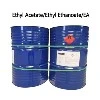

Yes, ethyl acetate (also known as ethyl ethanoate) is an ester. It is formed through the esterification reaction between ethanol (an alcohol) and acetic acid (a carboxylic acid).
Ethyl acetate (ethyl ethanoate, CAS 141-78-6) is an ester solvent formed by the esterification of ethanol and acetic acid. It contains a characteristic –COO– functional group and is classified as a low-molecular-weight aliphatic ester widely used in industrial solvent applications.
what is the chemical structure of ethyl acetate?
Ethyl acetate (ethyl ethanoate, CAS 141-78-6) has an ester structure (–COO–) with molecular formula C₄H₈O₂ and molecular weight 88.11 g/mol, higher than acetone (58.08 g/mol).

Properties of Ethyl Ethanoate
| Property | Description |
|---|---|
| Appearance | Colorless liquid with a fruity odor |
| Boiling Point | Approximately 77°C (171°F) |
| Density | About 0.9 g/mL |
| Solubility | Slightly soluble in water; highly soluble in organic solvents |
| Reactivity | Stable under normal conditions; may hydrolyze with strong acids or bases |
industrial uses of ethyl acetate
In industrial supply chains, ethyl acetate is widely used as a fast-evaporating solvent for coatings, inks, adhesives, and pharmaceutical intermediates. Its evaporation rate is approximately 3–4 times faster than butanol, improving drying efficiency in surface coating production. Compared with acetone, ethyl acetate provides better control in film-forming processes due to its higher boiling point (77.1°C vs 56°C), reducing surface defects in large-scale industrial applications.