
Isopropanol and isopropyl alcohol deliver identical cleaning performance because they are the same chemical substance (2-propanol, CAS 67-63-0), and the real performance differences come from concentration, not naming.
Is there any chemical or performance difference between isopropanol and isopropyl alcohol in cleaning applications?
There is no chemical difference between isopropanol and isopropyl alcohol; both refer to the same molecule C₃H₈O (CAS 67-63-0), meaning their cleaning performance is fundamentally identical when purity is the same. Industrial products labeled as isopropanol or isopropyl alcohol are typically supplied in 70%, 91%, and 99% grades, and performance variation is driven entirely by water content rather than nomenclature.
For example, 70% IPA contains approximately 30% water, which enhances microbial penetration but reduces evaporation speed. In contrast, 91% IPA contains about 9% water, providing a balance between solvency and evaporation, which improves oil and residue removal efficiency while maintaining moderate wetting ability. 99% IPA contains ≤1% water, offering faster drying and lower residue formation.
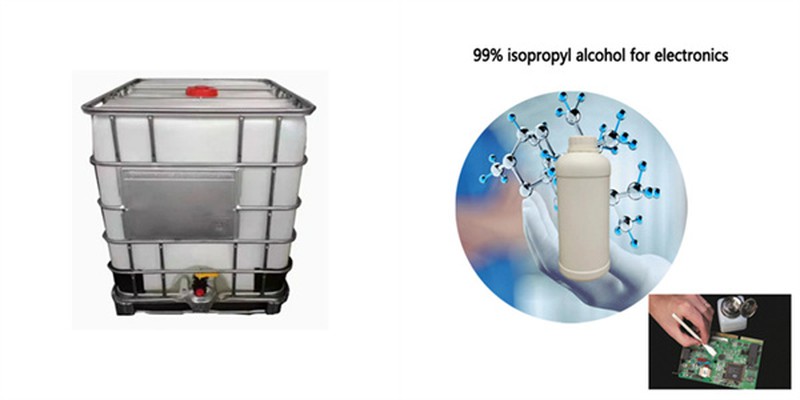
Isopropyl Alcohol Concentration Comparison (70% vs 91% vs 99%)
| Property / Performance | 70% IPA | 91% IPA | 99% IPA |
|---|---|---|---|
| Composition | 70% IPA + 30% water | 91% IPA + 9% water | ≥99% IPA + ≤1% water |
| Evaporation Speed | Slow (30–60 sec contact time) | Medium (15–30 sec) | Fast (5–15 sec) |
| Cleaning Efficiency | Excellent for biological contamination | Strong for oils & residues | Excellent for fast degreasing |
| Disinfection Efficiency | Highest (>99.9% microbial reduction in 30 sec) | Medium–High | Lower due to fast evaporation |
| Water Content Effect | Improves microbial penetration | Balanced effect | Minimal penetration |
| Electronics Safety | Lower (moisture risk) | Moderate | Highest safety (low moisture) |
| Typical Industrial Use | Medical, sanitation, surface disinfection | Electronics, industrial cleaning | Precision cleaning, drying, labs |
Which grade performs better in industrial, electronics, and pharmaceutical cleaning?
Performance depends on application sensitivity rather than chemical identity. In industrial cleaning, 99% IPA is commonly used for metal degreasing, resin cleaning, and coating surface preparation, where moderate moisture does not impact performance. In electronics manufacturing, however, 99% IPA (or higher purity grades) is required, especially for PCB cleaning and semiconductor processes, where moisture tolerance is typically very low. In pharmaceutical and medical environments, 70% IPA is often preferred because water content enhances protein denaturation efficiency, improving disinfection effectiveness by up to 20–30% compared to absolute alcohol. In contrast, higher-purity IPA is preferred for sterilizing equipment surfaces where residue control is critical. This creates a clear industry segmentation: 70% for disinfection, 91% for balanced industrial cleaning, and 99% for precision and low-moisture applications.
How do safety, handling, and operational conditions influence cleaning performance?
Safety characteristics are identical regardless of naming, but formulation differences significantly affect handling performance. Both isopropanol and isopropyl alcohol have a flash point of approximately 11.7°C, classifying them as GHS Category 2 flammable liquids, requiring controlled storage and ventilation. However, evaporation rate differences influence workplace safety and process design. For example, 99% IPA evaporates faster, increasing vapor concentration in enclosed environments by up to 15%–25% compared to 70% solutions, which can impact ventilation requirements. 91% IPA provides a more balanced evaporation profile, reducing rapid vapor buildup while maintaining effective drying. In storage conditions, higher-purity IPA is more hygroscopic and can absorb up to 0.2%–0.3% water within 24–48 hours if containers are not tightly sealed, gradually reducing performance quality. Transport classification remains UN1219, but industrial users often apply stricter sealing practices for higher-purity grades to maintain stability.
Isopropanol vs Isopropyl Alcohol for Cleaning-Which Grade Delivers Better Performance?
Cleaning performance is not determined by whether the label reads "isopropanol" or "isopropyl alcohol," but by concentration and application requirements. From a technical standpoint, 99% IPA delivers the highest performance in drying speed, residue control, and precision cleaning, while 91% IPA provides a balanced option between cleaning strength and evaporation control, and 70% IPA offers superior biological activity for disinfection applications. In industrial procurement practice, usage is typically divided as 30–40% 99% IPA for precision applications, 30–40% 91% IPA for general industrial cleaning, and 20–40% 70% IPA for sanitation and medical use, reflecting a practical balance between performance requirements and operational cost. Therefore, selecting the correct grade-not the name-is what determines actual cleaning effectiveness in industrial systems.
Tianjin Gnee Biotech Co., Ltd. is a professional manufacturer and exporter of isopropanol and other chemical raw materials, providing stable quality products, strict quality control, and reliable bulk supply for global industrial buyers.