


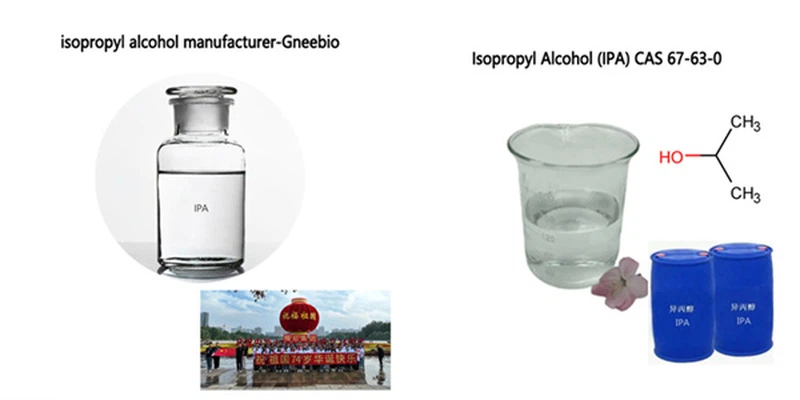
Isopropyl alcohol and isopropanol alcohol are not different chemicals; they are the same substance (2-propanol, CAS 67-63-0) and the performance difference comes entirely from purity grade rather than naming.
Is there any real chemical difference between isopropyl alcohol and isopropanol alcohol?
There is no chemical or functional difference between isopropyl alcohol and isopropanol alcohol; both refer to the same molecular structure C₃H₈O (CAS 67-63-0). In global chemical trade, these names are used interchangeably across industrial, pharmaceutical, and laboratory sectors. Industrial specifications typically classify the product into 70% IPA, 91% IPA, and 99% IPA grades, where performance variation is determined by water content rather than terminology. For example, 70% IPA contains approximately 30% water, which significantly improves microbial penetration, while 91% IPA contains 9% water, providing a balance between solvency and evaporation control. In contrast, 99% IPA contains ≤1% water, offering fast evaporation and minimal residue formation. In semiconductor-grade applications, even 0.5% moisture deviation can affect surface resistivity and process stability, making purity control more critical than naming conventions.
How do different IPA grades affect cleaning performance and industrial efficiency?
Cleaning performance varies significantly across concentration levels. In comparative industrial usage, 99% IPA evaporates 20–40% faster than 70% IPA at 20–25°C ambient conditions, making it highly effective for rapid degreasing and surface drying. However, 70% IPA demonstrates superior disinfection efficiency, achieving >99.9% microbial reduction within approximately 30 seconds of contact time due to improved protein denaturation facilitated by water content. The 91% IPA grade serves as a transitional industrial solvent, reducing drying time by approximately 15–25% compared to 70% IPA, while maintaining better solvency for oils and organic residues. In electronics cleaning, residue thresholds are often below 50–100 ppm ionic contamination, and higher-purity IPA grades are required to prevent corrosion and electrical instability. These performance differences show that concentration directly determines functional efficiency across industrial cleaning processes.
What are the key industrial applications of different isopropyl alcohol grades?
Different IPA grades are used strategically across industries based on performance requirements.
- 70% IPA is widely used in healthcare, sanitation, and surface disinfection, where water content enhances antimicrobial penetration and increases biological effectiveness by approximately 20–30% compared to absolute alcohol formulations.
- 91% IPA is commonly used in industrial cleaning, electronics maintenance, and general degreasing, where balanced evaporation prevents excessive drying speed while maintaining effective solvent action.
- 99% IPA is primarily used in precision manufacturing, semiconductor processing, and high-end coating preparation, where moisture tolerance is typically below 0.1% and even trace water can disrupt process stability. In PCB cleaning applications, particle control below 0.1 µm is required, while optical and laboratory applications often require residue levels below 50 ppm, making high-purity IPA essential for these environments.
| Property | IPA 70% | IPA 91% | IPA 99% |
|---|---|---|---|
| Alcohol content | 70% | 91% | 99% |
| Water content | 30% | 9% | <1% |
| Evaporation rate | Slow (30–60 seconds) | Medium (15–30 seconds) | Very fast (5–15 seconds) |
| Disinfection efficacy | Excellent (optimal) | High | Reduced (insufficient contact time) |
| Solvent / degreasing strength | Moderate | Strong | Very strong |
| Safe for electronics | No (moisture risk) | Moderate (limited use) | Yes (fast-drying, low residue) |
| Safe for skin | Yes | Yes (mild drying) | No (drying / irritating) |
| Flammability | Lower risk | Medium | Higher risk |
| Cost | More affordable | Medium | More expensive |
| Best application | Disinfection, healthcare, household | Industrial cleaning, electronics maintenance | Electronics, precision industry, lab cleaning |
How do safety and handling requirements differ across IPA grades?
Safety classification is identical for all isopropyl alcohol grades, with a flash point of approximately 11.7°C, classifying them as GHS Category 2 flammable liquids. However, operational handling differs due to evaporation and hygroscopic behavior. For example, 99% IPA evaporates faster, increasing vapor concentration in confined spaces by 15–25% compared to 70% IPA, which can influence ventilation system design in industrial facilities. In storage conditions, high-purity IPA can absorb up to 0.2–0.3% moisture within 24–48 hours if containers are not properly sealed, gradually reducing product purity. The 91% grade offers improved stability against rapid moisture variation, while 70% IPA is less sensitive to atmospheric humidity but introduces higher water-related corrosion risks in precision applications. Transport classification remains UN1219, but anhydrous and high-purity grades often require stricter sealing protocols such as nitrogen blanketing in bulk storage systems.
Why Partner with Us for Your IPA Needs?
Tianjin Gnee Biotech Co., Ltd. is a dedicated manufacturer and supplier of Isopropyl Alcohol (IPA). We understand the critical role this chemical plays in your industrial and pharmaceutical operations, and we are committed to providing stable quality, competitive pricing, and a reliable supply chain.
We offer IPA in multiple grades, from industrial-grade for degreasing and cleaning applications to high-purity USP-grade for pharmaceutical and formulation use. Each batch is produced under strict quality control to ensure consistent performance and compliance with industry requirements.
With strong production capacity and export experience, we support bulk supply with flexible packaging options and efficient logistics solutions. Our focus is to help customers achieve stable sourcing and cost-effective procurement for long-term cooperation.
Contact us today to request a quotation and discuss how we can meet your specific requirements with reliable Isopropyl Alcohol supply.


