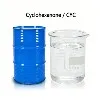


Cyclohexanone is a polar aprotic solvent with moderate polarity, not a nonpolar compound. Its polarity is caused by the carbonyl (C=O) functional group, which generates a permanent dipole moment due to the electronegativity difference between oxygen and carbon. Although it contains a nonpolar cyclohexane ring, the carbonyl group dominates its overall chemical behavior and determines its industrial solvent performance.

cyclohexanone chemical properties
Cyclohexanone is a saturated cyclic ketone with the molecular formula C₆H₁₀O and a molecular weight of 98.15 g/mol. It is registered under CAS No. 108-94-1 and EC No. 203-631-1 and is widely produced via cyclohexane oxidation or phenol hydrogenation.
cyclohexanone physical properties
Cyclohexanone(Cas Number 108-94-1) is a colorless to pale yellow liquid with a mild acetone-like odor. It has a boiling point of 155–156 °C, a melting point of -47 °C, and a density of approximately 0.947 g/mL at 25 °C. It is classified as a flammable liquid under Class 3 with UN number 1915, and it requires standard chemical handling procedures during storage and transportation.
Why Cyclohexanone Is Polar?
The polarity of cyclohexanone originates from its carbonyl group, where oxygen has significantly higher electronegativity than carbon, creating a strong dipole bond. This dipole cannot be canceled by the surrounding cyclohexane ring structure, resulting in an overall polar molecular character. For this reason, cyclohexanone is classified as a polar aprotic solvent rather than a nonpolar hydrocarbon.

cyclohexanone water solubility
Cyclohexanone is moderately soluble in water, typically around 80–90 g/L at 20 °C. Its limited water miscibility is caused by hydrogen bonding interactions through the carbonyl group combined with the hydrophobic effect of the cyclohexane ring. This balance allows it to interact with both polar and nonpolar systems while maintaining phase separation behavior in aqueous environments.
Organic Solvent Compatibility
Cyclohexanone shows strong compatibility with a wide range of organic solvents including alcohols, ketones, esters, and aromatic hydrocarbons such as toluene and xylene. It may show partial compatibility with aliphatic hydrocarbons depending on formulation conditions. This broad compatibility makes it a versatile solvent in industrial chemical systems.
cyclohexanone uses in industry
Cyclohexanone is widely used as an intermediate and solvent in industrial chemical production. A major portion of global consumption is directed toward nylon manufacturing, where it serves as a precursor for caprolactam used in Nylon 6 and adipic acid used in Nylon 6,6 production. It is also widely used in coatings, adhesives, printing inks, agrochemicals, and fine chemical synthesis due to its balanced solvency performance.

Key Physical and Chemical Data
| Property | Value |
|---|---|
| CAS Number | 108-94-1 |
| Molecular Formula | C₆H₁₀O |
| Molecular Weight | 98.15 g/mol |
| Polarity | Polar aprotic solvent |
| Boiling Point | 155–156 °C |
| Melting Point | -47 °C |
| Density | ~0.947 g/mL (25 °C) |
| Flash Point | ~44 °C |
| Water Solubility | ~80–90 g/L (20 °C) |
| Hazard Class | Flammable Liquid (Class 3) |
| UN Number | 1915 |
cyclohexanone safety
Cyclohexanone should be handled as a flammable industrial solvent with proper ventilation and safety controls. Exposure may cause irritation to the eyes and respiratory system and may lead to dizziness or drowsiness at high concentrations. It should be stored away from ignition sources and oxidizing agents in accordance with applicable safety regulations and industry standards.
FAQ
Is cyclohexanone polar or nonpolar?
Cyclohexanone is a polar aprotic solvent. Its polarity is caused by the carbonyl group, which creates a permanent dipole moment, making the molecule polar despite its nonpolar hydrocarbon ring.
Is cyclohexanone soluble in water?
Cyclohexanone is moderately soluble in water, typically around 80–90 g/L at 20 °C. It is not fully miscible because the hydrophobic cyclohexane ring limits complete interaction with water molecules.
Why is cyclohexanone used as an industrial solvent?
Cyclohexanone is used as an industrial solvent because it has balanced polarity, allowing it to dissolve both polar resins and nonpolar polymer materials. This makes it useful in coatings, adhesives, and ink formulations.
What is the main industrial use of cyclohexanone?
The main industrial use of cyclohexanone is as a precursor in nylon production, particularly for caprolactam (Nylon 6) and adipic acid (Nylon 6,6). It is also widely used in coatings and chemical synthesis.
Is cyclohexanone a hazardous chemical?
Yes, cyclohexanone is classified as a flammable liquid (Class 3, UN 1915). It may cause irritation and should be handled with proper industrial safety procedures and ventilation.
Does cyclohexanone mix with organic solvents?
Yes, cyclohexanone is compatible with many organic solvents such as alcohols, ketones, esters, and aromatic hydrocarbons. This makes it highly versatile in industrial formulations.
Conclusion
Cyclohexanone is a polar aprotic cyclic ketone with moderate polarity that determines its solubility behavior and industrial performance. Its dual interaction capability with both polar and nonpolar substances makes it a key raw material in nylon production, coatings, adhesives, and specialty chemical industries worldwide.