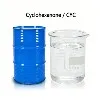

Cyclohexanone (CYC) is classified as a non-aromatic compound because it does not satisfy the fundamental requirements for aromaticity. Although it contains a six-membered carbon ring similar to benzene, its molecular structure lacks a continuous conjugated π-electron system and does not meet Hückel's 4n+2 rule.
As a result, cyclohexanone behaves as a cycloaliphatic ketone rather than an aromatic compound. This distinction is important not only in organic chemistry but also in understanding cyclohexanone's industrial applications as a solvent and chemical intermediate.

What Makes a Compound Aromatic?
A compound is considered aromatic only when it satisfies all four of the following conditions:
- It must be cyclic.
- It must be planar.
- Every atom in the ring must participate in a continuous conjugated p-orbital system.
- It must contain 4n+2 delocalized π electrons according to Hückel's Rule.
Benzene is the most well-known aromatic compound because its six carbon atoms are all sp² hybridized, creating a planar ring with six delocalized π electrons.
This delocalized electron cloud gives benzene its exceptional stability and characteristic aromatic behavior.

Why Does Cyclohexanone Fail the Aromaticity Requirements?
Cyclohexanone (C₆H₁₀O) contains a six-membered ring with a ketone functional group (C=O).
While the carbonyl carbon is sp² hybridized, the remaining ring carbons are predominantly sp³ hybridized. These sp³ carbons interrupt electron delocalization around the ring and prevent the formation of a continuous conjugated system.
Unlike benzene, cyclohexanone cannot establish uninterrupted p-orbital overlap throughout the ring structure.
Therefore, it fails one of the most important requirements for aromaticity.

Is Cyclohexanone Planar?
No.
Cyclohexanone adopts a chair-like conformation similar to cyclohexane.
This three-dimensional structure minimizes ring strain and is energetically favorable. However, the non-planar geometry prevents effective overlap of p orbitals around the ring.
Because aromatic compounds must be planar to allow electron delocalization, cyclohexanone's chair conformation further confirms its non-aromatic nature.
Does Cyclohexanone Satisfy Hückel's Rule?
No.
Cyclohexanone contains only one carbonyl double bond, which contributes two π electrons.
However, these electrons are localized within the C=O bond rather than delocalized around the ring.
In contrast, benzene contains six delocalized π electrons that satisfy Hückel's Rule (4n+2, where n = 1).
Since cyclohexanone lacks both a continuous conjugated system and the required π-electron count, it does not meet the criteria for aromaticity.
Cyclohexanone vs Benzene: Why One Is Aromatic and the Other Is Not
| Property | Benzene | Cyclohexanone |
|---|---|---|
| Molecular Formula | C₆H₆ | C₆H₁₀O |
| Functional Group | None | Ketone (C=O) |
| Ring Geometry | Planar | Chair-like |
| Conjugation | Continuous | Interrupted |
| π Electrons | 6 Delocalized | 2 Localized |
| Hückel's Rule | Satisfied | Not Satisfied |
| Classification | Aromatic | Non-Aromatic |
This comparison clearly shows why benzene possesses aromatic stability while cyclohexanone does not.
Is Cyclohexane Aromatic?
Cyclohexane is also non-aromatic.
Although it contains a six-membered carbon ring, all carbon-carbon bonds are single bonds. The molecule contains no π-electron system and therefore cannot achieve aromatic stabilization.
Cyclohexane and cyclohexanone are both classified as cycloaliphatic compounds.
The key difference is that cyclohexanone contains a ketone group, making it more reactive and significantly more useful as an industrial intermediate.

How Does Non-Aromatic Structure Affect Cyclohexanone's Chemical Behavior?
The absence of aromatic stabilization makes cyclohexanone considerably more reactive than benzene.
Instead of undergoing electrophilic substitution reactions like aromatic compounds, cyclohexanone readily participates in:
- Nucleophilic addition reactions
- Reduction to cyclohexanol
- Oxidation to adipic acid
- Condensation reactions
- Oxime formation for caprolactam production
These reactions are characteristic of ketones and contribute directly to cyclohexanone's importance in industrial chemistry.
Why Is Cyclohexanone Important Industrially?
Cyclohexanone (CAS No. 108-94-1) is one of the most important intermediates in the nylon industry.
cyclohexanone application include:
Nylon Production
Cyclohexanone is converted into caprolactam, the primary raw material for Nylon 6 production. It can also be oxidized into adipic acid, which is used to manufacture Nylon 6,6.
Solvent Applications
Due to its strong solvency and moderate evaporation rate, cyclohexanone is widely used in:
- Paints and coatings
- Printing inks
- Adhesives
- Resins
- Chemical processing
Chemical Synthesis
Cyclohexanone serves as a building block for:
- Pharmaceutical intermediates
- Agrochemical products
- Fine chemicals
- Specialty polymers
Cyclohexanone is non-aromatic ketone structure is largely responsible for the reactivity that makes these applications possible.

Conclusion
Cyclohexanone is classified as a non-aromatic compound because it fails to satisfy the essential requirements for aromaticity. Its chair-like structure is non-planar, its π electrons are localized within the carbonyl group, and its ring lacks a continuous conjugated system. Unlike benzene, cyclohexanone does not meet Hückel's Rule and therefore cannot benefit from aromatic stabilization.
This non-aromatic nature gives cyclohexanone the chemical reactivity that makes it valuable as an industrial solvent and a key intermediate in nylon, coatings, resin, and chemical manufacturing applications.