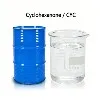

What Is Cyclohexanone?
Cyclohexanone (CAS Number: 108-94-1) is an organic compound with the molecular formula C₆H₁₀O and a molar mass of 98.14 g/mol, and it belongs to the class of alicyclic ketones in which a six-membered cyclohexane ring contains one methylene group replaced by a carbonyl group (C=O), which is the defining functional group of ketones.
Cyclohexanone is a high-boiling solvent with controlled evaporation characteristics, and compared with low-boiling solvents such as acetone or MEK, it provides better resin dissolution performance for epoxy, vinyl, and PVC systems, while also improving film formation, reducing coating defects such as blushing or whitening, and enhancing surface leveling in high-solid coatings. In industrial applications, approximately 90% of global cyclohexanone production is consumed in the manufacture of caprolactam and KA oil derivatives, which are key intermediates in Nylon 6 and Nylon 66 production, making cyclohexanone a core material in the global polyamide supply chain.

Key Chemical Information
| Property | Value |
|---|---|
| Chemical Name | Cyclohexanone |
| CAS Number | 108-94-1 |
| Molecular Formula | C₆H₁₀O |
| Molecular Weight | 98.14 g/mol |
| IUPAC Name | Cyclohexan-1-one |
| Appearance | Colorless to pale yellow liquid |
| Odor | Sweet, peppermint-like odor |
| Boiling Point | 155.4°C |
| Melting Point | -47°C |
| Density | 0.947–0.948 g/cm³ (20°C) |
| Flash Point | 44°C (Closed Cup, ASTM D93) |
| Water Solubility | ~23 g/L (20°C) |
| UN Number | 1915 |
| Hazard Class | 3 (Flammable Liquid) |
what is the structure of cyclohexanone?
The chemical structure of cyclohexanone consists of a six-membered non-planar carbon ring in which one carbon atom is bonded to a carbonyl group (C=O), and this structure combines the stability of a saturated cyclohexane ring with the reactivity of a ketone functional group, which is responsible for its chemical behavior in industrial reactions.
In its most stable form, cyclohexanone adopts a chair-like conformation similar to cyclohexane in order to minimize ring strain, although the presence of the carbonyl group slightly distorts the ideal geometry of the ring system.
The carbonyl carbon is sp² hybridized and forms a trigonal planar geometry with bond angles of approximately 120 degrees, while the remaining five carbon atoms in the ring are sp³ hybridized with tetrahedral geometry of approximately 109.5 degrees.
The C=O bond is highly polar due to the electronegativity of oxygen, which enables cyclohexanone to undergo typical ketone reactions such as nucleophilic addition, oxidation, reduction, and condensation reactions.
Cyclohexanone is structurally distinct from cyclohexane because cyclohexane has the molecular formula C₆H₁₂ and contains no functional groups, making it significantly less reactive, whereas cyclohexanone has a carbonyl group that increases its chemical reactivity and industrial value.
How is cyclohexanone made industrially?
Cyclohexanone is primarily produced through the oxidation of cyclohexane, where benzene is first hydrogenated to form cyclohexane, which is then partially oxidized to produce a mixture of cyclohexanol and cyclohexanone known as KA oil, and this intermediate mixture is further processed and separated to produce caprolactam and adipic acid, which are then used in the production of Nylon 6 and Nylon 66, making cyclohexanone an essential intermediate in this entire production chain.

What are the industrial uses of cyclohexane?
Cyclohexanone is mainly used in nylon production, where approximately 90% of global consumption is directed toward the production of caprolactam and KA oil intermediates, which are essential for manufacturing Nylon 6 and Nylon 66 used in engineering plastics, textile fibers, and automotive components.
It is also widely used as a high-performance industrial solvent in coatings, adhesives, inks, and PVC or CPVC cement systems because it provides strong solvency for high-molecular-weight resins, controlled evaporation rates, and improved surface leveling and film quality.
In addition, cyclohexanone is used as a chemical intermediate in the production of plasticizers, rubber chemicals, pharmaceutical intermediates, and specialty resins.

reactions of cyclohexanone
Cyclohexanone (CYC) undergoes several important chemical reactions including nucleophilic addition reactions with reagents such as Grignard reagents and hydroxylamine, oxidation reactions that lead to the formation of adipic acid via the KA oil route, reduction reactions that produce cyclohexanol, and aldol condensation reactions under catalytic conditions, all of which are important in industrial organic synthesis.
cyclohexanone safety
| Item | Specification |
|---|---|
| UN Number | 1915 |
| Hazard Class | 3 |
| Packing Group | III |
| Main Hazards | Flammable liquid, skin/eye irritation |
| Storage Condition | Keep away from heat, sparks, oxidizers |
Is Cyclohexanone Aromatic?
Cyclohexanone is not an aromatic compound because it does not contain a conjugated π-electron system and does not satisfy Hückel's rule for aromaticity, and it is therefore classified as a non-aromatic alicyclic ketone.
Conclusion
Cyclohexanone (C₆H₁₀O) is a cyclic ketone defined by a six-membered carbon ring containing a carbonyl group, and this structure provides a unique balance of stability and reactivity that makes it essential in nylon production, industrial solvent applications, and chemical synthesis, and it remains a critical intermediate in the global chemical industry due to its central role in polymer manufacturing and high-performance formulation systems.