Yes. Acetone and xylene are fully miscible at normal temperatures, and they do not separate on their own. What matters is the blend ratio: acetone flashes off about eight to ten times faster than xylene, so the mix ratio decides drying time, solvency and flammability. Before blending, check the resin system, the substrate and your local VOC rules.
Tianjin Gnee Biotech Co., Ltd. supplies acetone (CAS 67-64-1) and xylene in drums, IBC totes and ISO tanks for industrial buyers.
How Do Acetone and Xylene Differ?
Acetone is a polar ketone. Xylene is a nonpolar aromatic hydrocarbon. They dissolve different things, evaporate at very different speeds, and are regulated differently.
| Property | Acetone | Xylene (mixed) |
|---|---|---|
| Chemical type | Ketone (polar aprotic) | Aromatic hydrocarbon |
| Boiling point | About 56°C | About 138–144°C |
| Flash point | About −20°C | About 25–32°C, varies with composition |
| Relative evaporation rate (n-butyl acetate = 1) | About 6–7 | About 0.6–0.8 |
| US EPA VOC status | Exempt | Counted as VOC |
| UN number | UN1090 | UN1307 |
| Effect on common plastics | Attacks polystyrene, ABS, acrylic and polycarbonate | Can swell certain rubbers and soften some plastics |
The VOC exemption is the point formulators ask about most. In regions that follow EPA-style VOC rules, replacing part of the xylene with acetone can lower the VOC content of a coating or cleaning product. Check the rules in your own market, because exemptions are not the same everywhere.
What Happens at Different Mix Ratios?
You cannot average the properties of the two solvents. The more acetone you add, the faster the blend dries and the more it favors polar resins. The more xylene you add, the slower the blend flashes off, which gives more open time for brushing or spraying.
| Blend tendency | Drying | Solvency | Typical direction |
|---|---|---|---|
| Acetone-rich | Very fast | Strong on polar resins (epoxy, acrylic, nitrocellulose) | Quick-dry cleaners, tool and equipment cleanup |
| Balanced | Moderate | Broad range | Reducer for resin systems that tolerate both |
| Xylene-rich | Slow | Strong on oil-based and alkyd residues | Slower-drying thinners, greasy or bituminous residues |
Always run a small bench test. A fast-evaporating blend can chill the surface and cause blushing or a cloudy film in a humid workshop.
Acetone vs. Xylene as a Paint Thinner
- Epoxy, acrylic and nitrocellulose systems: acetone is the stronger and faster solvent. Too much can make the film dry before it levels out.
- Alkyd and oil-based paints: xylene is the more common choice, because its slower evaporation gives the paint time to flow.
- Blends: a small share of acetone in a xylene-based thinner speeds up drying. Some coating makers also use the blend to adjust viscosity.
- Use only the solvent the paint manufacturer approves. A thinner that is not on the data sheet can cause cratering, poor adhesion or a dull finish.
Xylene vs. Acetone for Cleaning
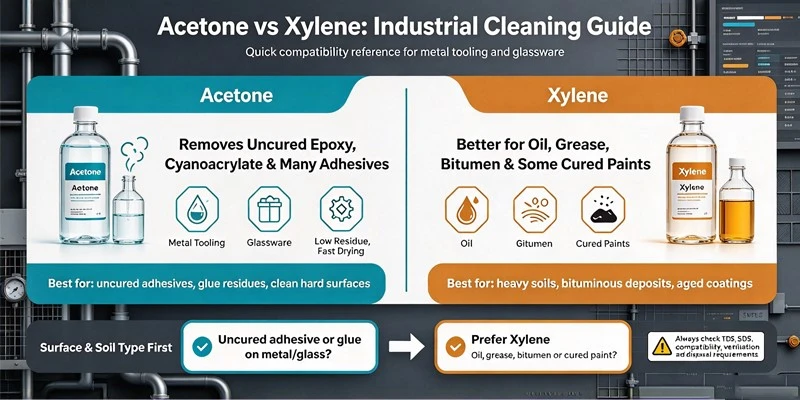
Acetone removes uncured epoxy, cyanoacrylate and many adhesives from metal tooling and glassware. It dries almost without residue.
Xylene is better for oil, grease, bitumen and some cured paints.
Avoid acetone on polystyrene, ABS, acrylic and painted surfaces. It can craze or dissolve them.
For electronics and moisture-sensitive parts, buyers normally choose isopropyl alcohol for cleaning instead of either solvent.
Test on a hidden area first, and follow the SDS for handling and exposure.
Safety Considerations When Mixing Acetone and Xylene
Both are flammable, and the blend is more dangerous than xylene alone. Do not estimate the flash point of a blend by averaging the two values. Any blend with a meaningful share of acetone should be handled as a highly flammable liquid with a flash point below room temperature, and the figure should be confirmed by test.
- Keep away from heat, sparks and open flames.
- Bond and ground containers during transfer to prevent static discharge, especially when pouring or pumping.
- Ventilate the work area to keep vapor concentrations low.
- Wear gloves, eye protection and other PPE specified by the SDS. Acetone and xylene can both pass through some glove materials, so confirm the glove type with the supplier.
- Store in labeled containers made for flammable liquids, away from oxidizers.
What Should Buyers Check Before Purchasing?
Grade and purity. State the acetone purity and impurity limits you need. For xylene, confirm whether you need mixed xylene or a single isomer such as o-xylene (CAS 95-47-6), and set a limit for ethylbenzene.
Application. Name the paint, resin or cleaning process, so the supplier can flag compatibility problems early.
Documents. Ask for the SDS and TDS up front, and a COA for each batch so that you can check it against the agreed specification.
Packaging and logistics. Confirm drum, IBC or ISO tank, destination and delivery terms. Both products ship as flammable liquids under their own UN numbers.
Not sure which grade fits your formulation? Send us your application and we will recommend the right acetone and xylene grades.
Frequently Asked Questions
Can acetone and xylene separate after mixing?
No. They are miscible in all proportions at normal temperatures. Separation in a finished product usually comes from other ingredients, such as water or incompatible resins.
Can you mix acetone and xylene for paint thinning?
Yes, for systems that tolerate both, but not for every paint. Check the paint maker's solvent list and test a small batch first.
Which evaporates faster, acetone or xylene?
Acetone, by a wide margin. Its evaporation rate is roughly ten times that of xylene under the same conditions.
Is acetone a VOC?
In the US, acetone is exempt from EPA's VOC definition. Xylene is not. Rules differ by country and region, so check your own market.
What documents should I request when buying acetone and xylene?
The SDS, the TDS, and a COA for each batch. Make sure they match the product actually being shipped.
Source Acetone and Xylene for Industrial Applications
Looking for a reliable solvent supplier? Request a COA, TDS or bulk quote for acetone and xylene and tell us your grade, volume and destination. You can also browse our full range of industrial solvents.