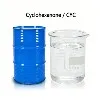

Cyclohexanone is only slightly to moderately soluble in water because it contains a polar carbonyl (C=O) group that can interact with water molecules through hydrogen bond acceptance and dipole–dipole interactions, while its large nonpolar six-carbon cyclohexane ring limits full miscibility. According to standard chemical safety references such as ILO ICSC 0425 and industrial SDS data, cyclohexanone is classified as slightly soluble in water, meaning it dissolves only up to a limited concentration before phase separation occurs.

Molecular Basis of Partial Water Solubility
Cyclohexanone (CAS Number: 108-94-1) has a dual structural nature that determines its solubility behavior. The molecule contains a polar carbonyl functional group, which creates a permanent dipole moment due to the electronegativity difference between oxygen and carbon. This allows cyclohexanone to act as a hydrogen bond acceptor when interacting with water molecules. However, it cannot donate hydrogen bonds because it lacks O–H or N–H bonds, which limits the strength of intermolecular interactions with water.
At the same time, the six-carbon cyclohexane ring is nonpolar and hydrophobic, which reduces compatibility with water's hydrogen-bonded network. This structural imbalance between a small polar region and a dominant nonpolar region is the fundamental reason for its partial solubility.
Why It Dissolves in Water but Only to a Limited Extent
Water is a highly polar solvent with strong intermolecular hydrogen bonding. The carbonyl oxygen in cyclohexanone can interact with water molecules at the interface, forming weak hydrogen bond acceptance interactions. These interactions are sufficient to allow limited dissolution and molecular dispersion in aqueous systems.
However, these interactions are weaker than water–water hydrogen bonds. As a result, only a finite amount of cyclohexanone can be stabilized in water. Once saturation is reached, excess cyclohexanone separates into a distinct organic phase.
Quantitative Solubility Range (Standard Reference Behavior)
At approximately 20°C, cyclohexanone typically shows water solubility in the range of:
- ~5–10 g/L (or equivalent low single-digit g/100 mL range depending on source and conditions)
This variation depends on temperature, purity, and measurement method. Importantly, it is significantly more soluble than nonpolar hydrocarbons, but far from fully miscible organic solvents.
For comparison, fully nonpolar cyclohexane is practically insoluble in water (<0.01 g/L), demonstrating the strong effect of introducing a polar functional group.
Structural Comparison With Cyclohexane
| Property | Cyclohexane | Cyclohexanone |
|---|---|---|
| Functional group | None | Carbonyl (C=O) |
| Polarity | Nonpolar | Weakly polar |
| Hydrogen bonding | None | Hydrogen bond acceptor only |
| Water solubility | Practically insoluble | Slightly soluble |
| Phase behavior | Immediate separation | Partial miscibility |
The presence of a single carbonyl group transforms cyclohexane from completely insoluble to partially soluble, but is not sufficient to achieve full miscibility.
Why Cyclohexanone Does Not Fully Mix With Water?
Full miscibility is prevented because the hydrophobic cyclohexane ring dominates the molecule's surface area and disrupts water's hydrogen-bond network. Water must reorganize its structured hydrogen bonding to accommodate the nonpolar region, which is thermodynamically unfavorable.
As a result, cyclohexanone reaches a solubility limit beyond which phase separation occurs.
Environmental and Industrial Relevance
The partial water solubility of cyclohexanone is important in industrial and environmental contexts. In coatings, adhesives, and agrochemical formulations, limited miscibility allows controlled blending in mixed solvent systems while maintaining phase stability.
From a regulatory perspective, cyclohexanone is recognized as a flammable organic solvent with moderate toxicity and is subject to handling requirements under OSHA, REACH, and ILO chemical safety frameworks. Its solubility also influences wastewater treatment considerations, as it can partially dissolve in aqueous effluents and requires controlled environmental management.
Conclusion
Cyclohexanone (CYC) is somewhat soluble in water due to the presence of a polar carbonyl group that enables weak hydrogen bonding with water molecules. However, its large nonpolar cyclohexane ring limits full miscibility. According to standard references such as ILO ICSC 0425 and industrial SDS data, it is classified as slightly soluble in water, exhibiting a balance between polar interaction and hydrophobic resistance that results in partial solubility rather than complete dissolution.